Showing posts with label Asia. Show all posts

Feb 28, 2015

Ireland, India

You may have noticed that both India and Republic of Ireland national flags are green and orange. But there are much more coincidences among the flags.

The tricolor flag of Republic of Ireland dates back from the first half of XIX century, but was revived for the Easter Rising (1916) and the Irish War of Independence soon after.


The orange represents the Protestantism (a reference to King William III of Orange, that inspired many Protestant banners), while the green represents the Catholicism (associated with Gaelicism). The white standed for the peace between that two religions...
Society of United Irishmen*Order of Orange

A peace that wouldn't last much. The Protestant-majority Northern Ireland opted to remain in United Kingdom while  the Catholic-majority remaining of the island gained the independence. Since then, the relationship between nationalists (that want Northern Ireland to join Republic of Ireland, usually Catholics) and unionists (that want it to remain in UK, usually Protestants) had ups and downs.

The flag of India was adopted in 1947. It's almost identical to the then-flag of Gandhi's party, the Indian National Congress, but with spinning wheel replaced by a Ashoka Chakra, representing the law and dharma.


The colors were chosen based in the most important religions of India: orange (officially described as "saffron") for Hinduism (probably borrowed from Maratha Empire), green for Islamism (probably taken from Mughal Empire) and white for the remaining religions.
Mughal Empire*Maratha Empire*

The flag, however, gained new symbolism. In the words of Sarvepalli Radhakrishnan, that would later became the second Indian president:
Bhagwa or the saffron colour denotes renunciation of disinterestedness. Our leaders must be indifferent to material gains and dedicate themselves to their work. The white in the centre is light, the path of truth to guide our conduct. The green shows our relation to (the) soil, our relation to the plant life here, on which all other life depends. The "Ashoka Chakra" in the centre of the white is the wheel of the law of dharma. Truth or satya, dharma or virtue ought to be the controlling principle of those who work under this flag. Again, the wheel denotes motion. There is death in stagnation. There is life in movement. India should no more resist change, it must move and go forward. The wheel represents the dynamism of a peaceful change.
The hope for an united India was short-lived: mainly-Muslim Pakistan (later divided in Pakistan and Bangladesh) wouldn't stay much time in the union, and the relationship between the two countries wouldn't be always friendly.

So similar in look, so similar destiny...

Comments and suggestions are welcome.

* Historical reconstructions.

Nov 24, 2014

Palestine [Larousse (1939)]

Last weeks, an image has been circulated in the internet, spreading a lot of lies. It's a photograph of the flags appendix of the 1939 edition of Larousse Encyclopedia [click to zoom]:

What's so polemic about it? In the second page, third row, third column, iy's possible to see a flag labelled as "Palestine", whose design is like below:

Many people have argued that it's an ultimate proof that, before United Nations, the British Mandate of Palestine had already a Jewish character. Firstly, it's not an absolute proof: although the Larousse is usually one of most reliable encyclopedias, its flag appendix isn't. In the same image, you can see other wrong flags, like that of Morocco and Soviet Union. Actually, the supposed Palestine flag also appeared in the 1933 edition, also unreliable.

But isn't still possible that this flag flew in the British Mandate of Palestine? Probably not. The only flag officially flown on the Mandate, apart from the Union Flag, was its civil ensign:

But they should have taken this flag from somewhere, shouldn't they? Yes, they should, but they could have invented as well. It's chronologically possible that this flag was inspired by the proposed flag of the 1924 Jewish Cultural Congress:

But the British Mandate of Palestine was still predominantly Jewish, wasn't it? Well, I'm not a specialist in the matter, but the Mandate also included the area of current Kingdom of Jordan, and, with the restrictions on Jewish immigrants, it's unlikely. Sorry, Internet...

Comments are welcome.

You can alo check the Flaglog post.

May 30, 2014

New Russia / Novorossiya, Russia (naval jack)

A new unrecognized nation, Novorossiya (literally, "New Russia"), appeared on Ukraine, claiming territories from Donetsk and Lugansk oblasts. According to current reports, it's unlikely to exist an official flag, but interesting proposals appeared on internet. I'll talk about two.

The first is from somebody nicknamed "arcktick". The photographs skillfully edited on Photoshop may have confused distracted Western sources, that often record them as widely used flags.

According to artist's page, the colors were chosen due to their wide use on Ukrainian oblast flags. Moreover, the flag can be obtained from combinations of Ukrainian and imperial and current Russian flags, as you can see below:

The second is the flag of New Russia Party, a Russophile Ukrainian flag behing the Novorossiya idea. Its flag, backed by many photographs, consists only of the white-blue-red of current Russian flag.

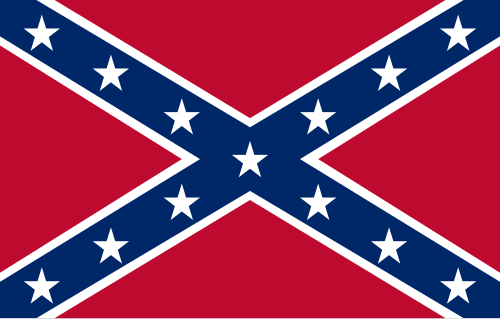
I've saw many Americans noticing the similarity between the flag above and the contemporary Confederate flag, but its most probable origin can be other: the Russian naval jack, below.

This flag consists of the union of St. George's and St. Andrew's cross, like the Great Britain flag, but on reverse order of colors. The naval jack was part of a set of flags designed by czar Peter I the Great himself. At the time, Peter I travelled to many European states, with the goal of forming an anti-Ottoman alliance (he failed) and modernizing Russia, and, on his stay on England, the Union ensign may have inspired him to create the Russian own jack.

But the flag, anyway, has a strong significance to Russia: St. Andrew, having preached along the Black Sea and region, is Russia's patron saint (curiously, Ukraine's, too), and St. George have been Moscow's city patron saint for centuries. The two saints also names important Russian military orders.

Comments (critiques, suggestions, corrections, additional info) is welcome.

Feb 28, 2014

Asano clan (Japan)

I've recently watched the 47 Ronin (2013) movie, and some flags that appeared on movie attracted my attention. Don't worry, no spoilers!

One of the patterns that appear more often on the movie is, as I was found on my research, the mon of the Asano clan. Asano Naganori was the daimyo of the samurais that would, during the movie, became the forty-seven ronin (masterless samurai) of the title; it was usual to commoners without mon to use those of their patrons or organization. That mon consists of falcon feathers in saltire; falcon feathers were a popular pattern for being used in arrows, and in decoration for some special occasion.

Many flags with this mon appear on the movie, for example on this scene (don't know about historical accuracy). Here's one of those flags I reconstructed:


Japanese mons are used even today as symbol of a family, organization or clan (similarly to Western coats of arms and badges), and are very simple and monochromatic. They commonly appear in architecture, personal marks and, on the age of the samurai, flags, specially during the battles.

The mon were excellent during samurai battles, as their simple designs could be easily used to distinguish friends and foes. As explained on a previous post, the Japanese mon is the base of the Japanese flags tradition.

Comments are welcome.

Sep 27, 2013

Thai Vexillological Association (Thailand)

I took knowledge about the activities of Thai Vexillological Association (TVA) for only few weeks. However, the work has been impressive, in my opinion, especially in their Facebook page (I recommend the visit).

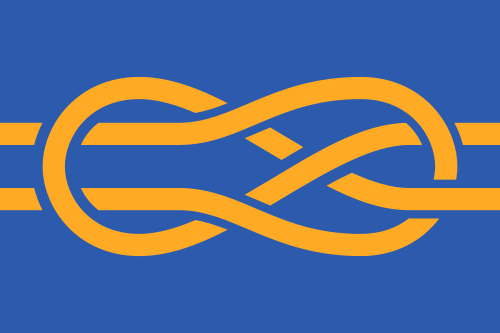
They also have a very clever flag:


The elephant comes from the flag used by Thailand from the 19th century until 1917; there were variants with a simple and an adorned with royal regalia elephant, and it was actually a white elephant on a red field. It seems obvious the option for the elephant as a royal symbol. On the top of the flag, there's a representation of the sheet knot, initially used by FIAV (Federation of International Associations of Vexillology) and then by many other associations of vexillology; the knot represents the nautical origins of the flags. The knot is adorned with the colors of the current Thailand flag.

The current Thailand flag was adopted in 1917. According to a story, the king Rama VI, when seeing the elephant flag flying upside-down, decided to adopt a totally symmetrical design. Initially, the middle stripe was red, but soon it was changed to blue. The symbology of the colors is the following: red for land and people, white for all religions, and dark blue for monarchy (the astrologers considered the color auspicious to Rama VI). Moreover, the flag was adopted during World War I, and had the same colors of the flags of some Allies: the USA, the United Kingdom and France. Having a good and exclusive design, the flag remains without problems since then.

Your comments are welcome.

Jul 26, 2013

Pakistan

Have you ever noticed that Pakistani flag is so different of the others and still one of most charming national flags in the world?

Let's take a look:


This white hoist makes the flag much more original than the average bichromatic flag, considering it's a very rare composition. Usually, a similar flag would have an unbalanced composition, but the strikingly simplicity of Pakistan flag manages it well.

The flag of Pakistan has a great symbolism, that can be used to explain the history of the country. The flag is based on the All-India Muslim League, that used basically the national flag without its white stripe. The green stripe represents the Islamism (Moghul Empire and the Sultanate of Delhi, some historical rulers of the region, used green flags), the same about the stars and crescent, although it's stated that the former also represents progress, and the latter, light.

The white stripe represents the peace between religions and the religious minorities of the country. Probably, this symbolism was kept from the Indian flag, where orange stands for Hinduism, green for Islamism and white for religious peace. Pakistan flag still represent the Islamic nature of the country, but also the promise for religious tolerance. A nice insight!

Your comments are welcome.

Jul 9, 2013

Libya, Syria and Egypt

After the last post, I received a request to review the flags of Libya and Syria. Suddenly, I gained a very nice topic, as the forks of the themes are surprisingly numerous. I chose one.

I'll start from the Gadhafi-era Libyan flag:


This flag was adopted when Gadhafi was putting the ideas of its "Green Book" in practice. The green color is associated with Islam since the Fatimid Caliphate, that used a green banner similar to the image above. A flag in full green express, then, the total devotion to Islam and the principles of "Green Book".

The flag is evidently simple, striking and easy to be manufactured, but I can't decide if the simplification is exaggerative or not. Some people liked it, others not. Just for curiosity, plain green flags are used in other parts of the world, like Beni, in Bolivia, and Candelaria, in El Salvador, but we can guess they are not related to Islamism.

After Gadhafi's deposition, a new flag was adopted; more precisely, the design is identical to the flag Libya used during its brief monarchy (1951-1969):


The black field and crescent and moon are derived of the Cyrenaica dynasty of the Senussi, that ruled the unified Libya. Red is for the blood shed on independence process, while green is related to the birth of a new country. Notice that the green in this flag has a different symbolism of the one in Gadhafi-era flag.

Now, starting with Syria (but without forgetting Libya), its current national flag:


This flag was originally adopted in 1958, when Syria and Egypt joined the United Arab Republic. The two stars represent, consequently, the two countries that formed the union. A third star was briefly adopted when Iraq tried to join them, but removed when the attempt failed (because Iraqi Ba'athist government was overthrown). The three stars also represented the three pillars of Ba'athism: unity, freedom and socialism. After that, Libya united Syria and Egypt on the then-named Federation of Arab Republics. The stars were then replaced by the hawk of Qureish (the tribe where Muhammad was born). A very similar flag is still used by Egypt, with the exception that the hawk of Quraish was substituted by the eagle of Saladin.

Syria on Federation of Arab Republics - with hawk of Qureish:


Egypt - with eagle of Saladin:


When the two stars were re-adopted by Syria, the symbolism was changed, although still representing the pan-Arabism: it's now a symbol of Arab unity.

Now, a little about the flag currently used by Syrian rebels:


This flag was the same Syria used after its independence. Here you find another connection to Libya, as Libyan rebels used to use the flags of a previous government (now reinstalled as national flag). The three stars represent the French districts of Aleppo, Damascus and Deir ez-Zor, that formed the unified Syria. The symbolism was soon changed, with the three districts being represented by only one star, with the two remaining representing the joining Sanjak of Latakia and Jebel Druze.

Concluding the text, I hope you noticed how much the flag histories of these three countries are connected. Also, I'd like to point that the examples I cited represent an important characteristic of Arab vexillology: the symbolism related to pan-Arabism. In a wider range, even the use of the pan-Arab colors is a result of this tendency, but no countries have showed this so prominently like Syria and Egypt, with the possible exception  of Iraq. If I can guess, I bet it's related to the influence of Arab nationalism and Arab socialism on the policy of those countries. But it's only a supposition, I may be wrong.

Your comments, suggestions and requests are welcome!

Jun 17, 2013

East Timor

Today, we'll look at the flag of one of newest nations in the world: East Timor. Look at this pretty piece:


I remember that the first time I saw the East Timor flag was on a stamp of my country, Brazil, commemorating the first anniversary of the independence of this friend nation, about a decade ago:


At the time, I was slightly more interested in stamps than in flags, but I became immediately curious with the shapes of that flag. I needed more months to found an updated flag section, I can't remember if on an atlas or in the internet.

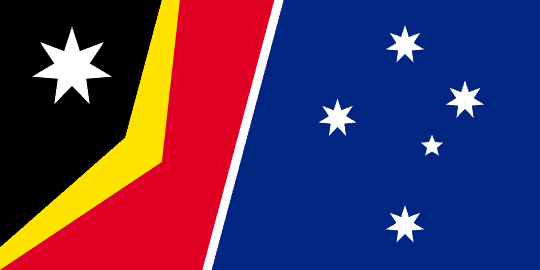
The "boomerang" shape thrilled me, and I still find it very original. Not coincidentally, it's very similar to a proposal to a new Australian flag. The inclined star is also very unique.

Now, a little about the meaning and history of this flag. The flag adopted in 2002 is the same used in 1975, during a brief period of independence. The black represents the "the obscurantism that needs to be overcome", according to official sources, while the yellow triangle represents the traces of colonialism. The red is for the fight for independence, and the white star (on the color of peace) represents the "light that guides". The symbolism, all in all, represents a young nation trying to overcome its problems and build a better future.
 
Your comments are welcome.

Apr 25, 2013

The history of Chinese flags

Flags are changes sometimes. Usually, it's because of a change of perception about the represent subject. I'll talk about it using the People's Republic of China (mainland China, not Taiwan) as example.

I'll take, as starting point to my explanation, the flag of China used between 1890 and 1911:


At the time, China was ruled by the Qing Dynasty (of Manchu ethnicity). Yellow was traditionally the imperial color of China, and the imperial family was the only that could use that color on clothes and buildings. The dragon has a well-known symbolism in Chinese culture, and the five-clawed one, like in the flag, was associated with the emperor. The red disc on the superior left is a flaming pearl, common on depictions of the Chinese dragon. It's someway related to the "Eight Banners" adopted by Manchu military organization.

In 1911, the China became a republic, after the Wuchan Uprising, and the flag was de facto replaced by the flag used by the rebels:


The eighteen disc represent the then eighteen provinces of China. There's a variant of this flag with a nineteenth star on the center of the star.

In 1912, a new flag was formally adopted; the Wuchan Uprising flag was kept as the Army flag until 1928. See it:


This flags was highly related with the new ideology of the Chinese policy, known as "Five Races Under One Union". Although the flag was intended to show certain harmony between the five races, they were placed in a order that shows a kind of ranking on Chinese society: red for the Han (the most numerous ethnicity on China), yellow for Manchu (notice the reference to first flag on post), blue for Mongols, white for the Hui (Muslims on China) and black for Tibetans.

The five-colored flag was used until 1928, with the exception of a brief period between 1915 and 1916, when occurred an attempt to restore the Chinese Empire. Two flag variants were used on that period:


The colors have the same symbolism, but now the Han ethnicity (represented by red color) takes a much more salient position on the flag.

In 1928, a new flag was adopted:


The flag replacement is again resulted by a radical change on policy. Between 1916 and 1918, in an event known as Northern Expedition, Chinese nationalists fought for the "reunification" of China through the disestablishment of local warlords. Red represent the blood of the martyrs that fought against Qing dynasty; the twelve-rays white sun on blue background represents the progress, symbolized by the twelve months and the twelve traditional Chinese hours (the shíchen), and was used as the symbol of Kuomintang party.

In 1949, with the result of Chinese Civil War, the troops of Chiang Kai-Shek were relocated to Taiwan islands and established the Republic of China (ROC), that still uses the 1928 flag, while the communists, led by Mao Zedong, established the People's Republic of China and adopted a new flag, still in use:


I don't need to explain that the red prominence is related to communism, do I? Also, there are five yellow stars, whose color may refer to the "yellow race" of the Chinese. The biggest star represents the Communist Part of China (CPC), representing the great "savior" of China. The four smaller stars represent the four constituent parts of the Chinese society: the rural workers, the proletariat, the urban petit bourgeoisie and the national bourgeoisie (whose representation on flag was controversial at the time). There's an alternate interpretation, probably dubious, that says the bigger star is for the Han ethnicity while the other stars represent the other four "races" of 1912-1928 flag.

So the Chinese flag changed from imperial to republican, then to representative, so then to nationalist and now to communist. Flags changed for ideological purposes, because they were all pretty cool, aesthetically and vexillologically.

Hope you liked the historical tour. Feel free to comment!

Nov 20, 2012

Fukui (Japan), Saga (Japan)

Japanese flags! Didn't you think that Japanese people, always surprising the "Western civilization", would have ordinary flags? Actually it has a rich and consolidated tradition about flags. Let's start with a good example: the flag of Saga prefecture.


It's positively a great flag! I like too much radial symmetry in flags, and it's a great example of it. It's simple, everybody could easily guard all details in memory and after all reproduce them. The flag represents camphor flower, in format of mon (see definition below). The white color represents justice, while red is for passion and loyalty. As a whole, the flag represents "a highly developing harmony".

A "mon" is a stylized figure used as familiar or personal insignia, similarly to Western crests and badges. Click here to confer a gallery of mons.

Now, I'll show the beautiful Fukui prefecture flag, that'll be used to explain other tradition on Japanese flags.


This flag is very colorful, isn't it? Japanese flags are very colorful, usually bicolor or tricolor. Every color can be used in Japanese flags, including some tones that are rare in West, like grey, brown, purple, teal, buff, brownish-green and rose color.

You may be asking yourself "What's this symbol?". This mon is a stylized version of Fukui name transcription in katakana ("フクイ"). A very common technique on these flags is use the name of the entity (or their first syllables) and stylize it as a mon.

I hope you liked the flags and the text. Your comment is welcome, and you're free to ask, suggest, praise, criticize or give your opinion.

Oct 16, 2012

Element of flags: color palettes

When you're talking about flag, "coincidences" sometimes aren't what they look like. Many times a flag is intentionally similar to another, when the first taking the second as inspiration. An example easy to notice and study are the color combinations. Some flags are very influential, in the sense that's took as base to many newer flags. Here you can see some of them, grouped by the inspiration.

Pan-African colors


There's two palettes of colors known as pan-African colors: one is composed by red, yellow and green, while the other contains red, black and green.

The first set of color (green, yellow and red) is inspired by the flag of Ethiopian Empire.


This three colors have been specially used in Ethiopia since about 17th century, but the flag was only adopted in 1897. The meaning of the colors is disputed, but generally it's said that red is for the blood spilled in defense of Ethiopia , yellow is for the peace and harmony between Ethiopian ethnic and religious groups, and green for hope or land's fertility. The insignia in the middle of the flag is the Lion of Judah, used because the Ethiopian Dynasty claimed to have ancestry from King Solomon and Queen of Sheba, being named Solomonic Dynasty.

As Ethiopia, with exception of a brief period of Italian rule, resisted strongly to European colonization, many countries adopted this colors when gained independence from European countries, as symbol of sovereignty. They are also much used by the Rastafari Movement.

Other set of colors also known as "Pan-African colors" are composed by red, black and green, derived from UNIA (Universal Negro Improvement Association) flag.


The UNIA was founded by Afro-American activist Marcus Garvey, in 1920. It's commonly said that red stands for African blood, black for the African people and green for continent's fertility. It was adopted as an   unofficial "Afro-American" flag and many African countries inspired in it to create their own flags.

Countries in Americas with great African-descendant population, e.g. St. Kitts and Nevis and Grenada, also adopted pan-African colors. See a small flag chart with some African countries with pan-African colors in their flag history:


[Click on images to zoom]

Pan-Slavic colors


Other great flags family is from pan-Slavic. They use the colors red, white and blue. It's important to notice that not all flags with these colors has pan-Slavic inspiration (like France, USA and UK). They are inspired by the flag approved by Pan-Slav Congress of 1848 (occurred in Prague). The colors, associated with freedom and revolution (e.g. French flag) and the same of Russian flag, were chose in a great number of Slavic countries. See the pan-Slavic flag and a flag chart with flags inspired by it.


Pan-Arab colors


Here's a challenge: can you say right now, without assistance, the differences between Kuwait and Jordan flags? You probably don't; if you can, congratulations, because flags of some Arab countries are very hard to be distinguished by non-Arabs. The reason is simple: they all have the same matrix, in this case the flag used during the Arab Revolt (1916-1918). Look at the flag:


The Arab revolt was an attempt to create an unified Arab country under territories of Ottoman Empire (ruled by ethnic Turks). The flag used during the revolt, considered Arab nationalist, was immediately adopted as symbol of Arab identity. See a set of recognized and unrecognized countries that adopt this colors:


It's important to notice that non-Arab Muslim countries, like Afghanistan and Pakistan, don't adopt this colors.

Pan-Iranian colors


Many flags are commonly thought to represent the pan-Arab colors, but actually represents the pan-Iranian colors, used by Persian people, majority in Iran, Tajikistan and Afghanistan. They're based in Persian flag (nowadays Iran); this one is from before 1906 (date unknown).


The small flag chart below show some flags using pan-Iranian colors:


Colors of Federal Republic of Central America


The Federal Republic of Central America (1823-1838) was a good attempt to hold together previous Spanish colonies in Central America, but the union disbanded, although until today they have friendship relationships and there were other attempts of reunification, e.g. the Greater Republic of Central America (1896-1898). See the flag of the Federal Republic:


The color of these flags are blue and white (Costa Rica added the red).


Colors of Gran Colombia


Finally, the last color-based flag family. In a similar case to Central America, the ex-constituent countries of Gran Colombia (officially Republic of Colombia; 1819-1831) adopted the colors of these countries. The unification ideology, influenced by the ideas of liberator Simón Bolívar, is having some voice last years. Gran Colombia used many flags, being the flag below the first and most famous of them:


The colors that defines this family are yellow, blue and red. Bolivia changed the blue by the green. See the flags of this family:


Ending...


This was a long post. Don't you think I deserve at least one comment? Please, if possible, subscribe to the blog. Thank you for reading!

Aug 30, 2012

Albania, Kingdom of Jerusalem

Today post is about rule of tincture, a tradition that came from heraldry but that everyone interested in flags design will need to know someday. Basically, it says that a color can't be placed over a color, and a metal can't be placed over a metal. Firstly, it's needed to know the heraldic concepts of color and metal.

Light tinctures, i.e. white and yellow, are considered metals. Darker tinctures, i.e. red, blue, green, purple and black, are called colors. Non-traditional tinctures use to be classified as colors, but some scholars defend the sky blue, buff-color and some metallic colors (e.g. iron, steel, bronze) are being metals .

The rule of tinctures is rigidly followed in United Kingdom and Anglophone countries. Nevertheless, in continental Europe, it's mostly used as a aesthetic recommendation, being exceptions more common there. I'll mention and explain two cases of broken rule, one of each case.


It's just a conjectural flag: maybe it was white over yellow instead of yellow over white, and the smaller cross could exist or not. Whatever it broke the rules of tinctures: yellow and white are both heraldic "metals". But there's some freedom in this case: the Kingdom of Jerusalem was a medieval crusader kingdom, so the combination of yellow and white was accepted just because of religious purposes (repair they're Vatican colors).


The rule is also broken in Albanian flag, but for inverse reason: it's considered, by heraldic scholars, "color" over "color". However, Eastern European tradition admit this: there's the marten and zibelline tinctures, looking exactly like red (gules) and black (sable), respectively, but treated as "furs" (a kind of heraldic texture), considered neutral to the rule.

By the way, a little explanation about Albanian flag history: the black double-head eagle over red background was present on the coat of arms of Kastriot family — George Kastriot Skanderbeg fought against Ottoman domination in XV century. In 1912, Albania gained independence from Ottomans again, and the model was remembered, and it has been used, with small changes, since then.

Did you like this post? Do you want to comment about Jerusalem or Albania flags? Have any doubt about the rule of tinctures? Leave a comment, please.

Aug 7, 2012

Japan

Today I'll denounce what is, for me, a historic injustice. Some people use to say "I'm lazier than the man that created Japanese flag". The Japanese flag is simple, but not silly, and I'll demonstrate it below. Now, let's see Japanese flag:


The Japanese flag consists of a red circle over a white background. The circle represents the sun, so the flag is know as Nisshōki ("sun-mark flag") or, more popularly, as Hinomaru ("sun circle" or "circle of the sun"). Why is this perfect to Japan? Because Japan = Sun. Let me explain better. In Japanese, the country is known as Nippon or Nihon, both meaning "sun's origin". The word "Japan" comes from Mandarin Cipan, that means "country of sun's origin". With translation to many languages, the country is known as "The Land of Rising Sun". Is there something better than a red circle to represent Japan? Maybe, but I don't know what.

An extra: The Japanese "Rising Sun" flag.


It's far better than Japanese national flag, almost plain. It's something like an improvement of anterior flag. But probably it'll never be adopted as national flag, and the reasons are many. It was used, until the end of World War II, as Japanese Empire war flag. So, in Japan, it's a symbol of far-right and, in neighbors countries, symbol of militarism and imperialism. An asymmetric version of this flag is still used by country's Navy. Unfortunately, the history doesn't honor the design.

I want to know your opinion about Japanese flag. Do you think it's a good flag, or that its creator is only less lazy than the previous Libyan flag's one? Give your comment.