Showing posts with label Oceania. Show all posts

Oct 3, 2015

New Zealand [five finalist proposals]

This November 20th, a new step in New Zealand flag referendum will be started: choosing the design that will compete with current flag the next.

There were four designs originally announced, but a fifth design was added.

The first design was made by Alofi Kanter:


I think it's pleasing for the eyes, and a big pro is the similarity with traditional silver fern flag, used by NZ in sports and other contexts. The silver fern is New Zealand's national plant and, possibly, its main national symbol. Maybe, due to its inspiration in NZ government branding, it looks too logo-ish.

The second design, by Kyle Lockwood was surfaced around 2003 and, having gained much popularity since then, it's place in final five is no surprise:


The key for its suceess is the link to current flag and british red-white-blue, but still showing the silver fern.

The third is by Kyle Lockwood, too. This design replaces red with black, as black and white are (together with red ochre) the national colors of the country, being a viable mix of current national flag and silver fern flag.


The fourth design was presented by Andrew Fyfe:


This design contains a reference to koru, a germinating silver fern that's an important symbol in Māori culture. It also resembles a wave, a cloud (one New Zealand's Māori name is Aotearoa, "the land of long white cloud") and ram's horns. It's my least favorite design of the five.

Originally, the final shortlist should countain only four flags, but a fifth design was add by popular pressure. This design was presented by Aaron Dustin:


This design, nicknamed "Red Peak Flag", has many inspiration, among them New Zealand's geography, the Union Jack and Māori creation myth (also represented in Tino rangatiratanga). Curiously, it's similar to a flag that won a private contest some months ago.

I like some of those designs more than others, but I think any of them can compete with NZ current flag with own merits. Whichever flag will the referendum, I'll probably have already reviewed it —pretty efficient, right?

Comments and suggestions are welcome.

This post should be posted in September, but I had technical issues. I'm sorry.

Jul 30, 2015

New Zealand [Studio Alexander's proposal]

The New Zealand flag referendum is soon to happen — next September, the four finalists will be selected. Meanwhile, economist and philanthropist Gareth Morgan organized a private contest for proposals of new NZ flags by "genuine designers". The winner entry was design by Auckland-based Studio Alexander.

This is the current New Zealand flag:


And this is $20,000 worthy winner entry, called wā kāinga (in Maori, something like "homeland"):


The design is not bad per se, but has received some critics for not including New Zealander symbols like the silver fern or the Southern Cross. The red triangle represents the Maori heritage, while the blue triangle stands for the British heritage, The black color is a NZ symbol independent of ethnicity, so represents country's multiculturalism (I think it's just curious that black is the union of all colors). The white shape is derivative from the maihi, a Maori bargeboard, and unites the other three colors.

Additional symbolism includes the similarity with Union Jack and Tino rangatiratanga, and the black triangle, that relates to the many mountains on the islands.

What do you think about this design? Comments are welcome.

Jun 30, 2015

Fiji [2015 finalists]

This June 30th, the public feedback channel of the 23 finalist designs will be closed and another round of the adoption of new Fijian national flag will start: the feedback will be sent to Parliament, where the new flag will be debated and chosen before October 10th, Fijian Independence Day.

This is the current Fiji flag:


It isn't an ingenious design, but the light blue of Pacific stands out. Having become a republic in 1987, the current Fiji government wants to drop the Union Jack, related to its colonial past.

From over 2,000 designs, a committee chose 23 designs, most of them mash-ups of different entries. As you can see, all entries contain the "Fiji blue", often combined with dark blue. Click to zoom:

The "mash-up" thing is evident: many entries follow the same pattern, possibly as a result of the initial intent of choosing only five designs. Entries 36 to 39, 46 and 52 to 53 follow the same dark-blue-triangle-on-hoist pattern; among them, I think #46 is the only one that's not too cluttered and work. You can see an abstract pattern in entries 42 to 44 and 56 to 57 and another on designs 40 to 41 and 54 and 55, and I'm not a fan of neither,

From remaining designs, we have #35, that's OK but not iconic enough for a national flag, the rest of them I think would be excellent choices, too. Among all, my favorite is design #47:


Now I have to speak a bit about the symbolism on all entries:

  • The light blue, as I previously told, is a link to current flag, and represents the Pacific Ocean, but also peace, serenity, freedom and the solidarity among all island nations.
  • Yellow is sun's color, thus represents radiance, life, sustenance and a new beginning. The sun stands for the same things, but also the warmth of Fijian people.
  •  Dark blue represents peace, prosperity, trust, dignity and intelligence, while red stands for the passion, strength and energy of Fijian people.
  • The triangle on hoist represents moving forward as a single people.
  • Stars represent guidance, navigation and direction. The number three represents the three branches of government (executive, legislative and judiciary), while seven is a number considered of good omen by most Fijians.
  • The Tagimoucia is a flower that only grows in Fiji, and is considered a symbol of blessings, peace and courage; the turtle represents humility, strength, patience and perseverance; the davui (conch shell trumpet) stands for community and respect, thus national unity; the drua represents Fiji's past, present and future, and the nation moving united towards future; tapa (cloth pattern) is a sign of Fijian heritage; and the coconut tree stands for sustenance and versatility.

It's importance to notice that Parliament can finally choose a design not among the 23 finalists, but popular feedback on those designs will be part of the debate. As soon as the final design is chosen, I'll send updates,

Comments and suggestions are welcome!

Mar 31, 2015

Māori people (New Zealand)

Now and then, the flag of the Māori, native Polynesian people from New Zealand, appears in media. These time, in the course of NZ flag debate, due to the upcoming referenda — even tough that design probably won't be considered, as it originally represents an ethnic group of the country, not the country as a whole.

This is the most famous Māori flag:


The colors of the flag — black, red (actually, red ochre) and white — are the official colors of the country, what many people out of the island don't know. The color symbolism in the flag is very significative: the black color presents the Te Korekore (the absolute nothingness) and Rangi (the heaven, the sky-father); red represents Te Whei Ao (coming into being) and Papatuanuku (the earth-mother); white stands for Te Ao Marama (realm of being and light), purity, enlightenment and harmony.

The design thus symbolize the Māori creation myth surrounding Rangi (the sky-father) and Papa (the earth-mother), as well as an ideal of harmony, in a very graphic and elegant way. The spiral pattern is similar to a koru and can remark the New Zealand's name in Māori language: Aotearoa, "the land of the long white cloud".

This flag is known as Tino rangatiratanga, an expression hard to be translated, but often did as "absolute sovereignty". This flag was designed by Hiraina Marsden, Jan Smith and Linda Munn, in 1990.

As I said in first paragraph, I have no hopes that it will become the next NZ flag, but the vexillologist inside myself would be more than happy if a design as beautiful as this was chosen.

Comments and suggestions!

As soon as the designs chosen for the referenda were announced, I'll return to the trend.

Aug 31, 2014

Tonga

If you had to choose a flag to be used forever, unchanged, how would it look like? Tonga made its choice already.

This is the flag of Tonga:


Since the 1840s, European missionaries arrived in the islands with the goal of converting the natives to Christianity. They were successful: according to last census, more than 90% of the population profess a branch of this religion.

When the first king of Tonga converted to Methodism, he adopted a flag consisting of a red cross on a white field, representing purity.

The flag was changed in 1866, putting the old flag as a canton of the red field, representing the Blood of Christ shed on crucifixion. A reason commonly attributed to the change was the fact it was identical to the White Cross' flag, adopted by the Geneva Conventions two years earlier. It's not clear if the similarity with a British red ensign was intended or not, since Tonga was then a British protectorate.

According the current Tonga constitution act, from 1875, this flag "can never be altered" and "shall always be the flag". Obviously, the flag could be changed after a new constitution. As this flag doesn't have political signs, the only reasons I can think to replacing it is either Christianism losing relevance on the country or people bore with this bold and elegant design. None of them seems near to happen, so it's a good bet if this flag lasts forever...

Comments are welcome!

Jun 17, 2013

East Timor

Today, we'll look at the flag of one of newest nations in the world: East Timor. Look at this pretty piece:


I remember that the first time I saw the East Timor flag was on a stamp of my country, Brazil, commemorating the first anniversary of the independence of this friend nation, about a decade ago:


At the time, I was slightly more interested in stamps than in flags, but I became immediately curious with the shapes of that flag. I needed more months to found an updated flag section, I can't remember if on an atlas or in the internet.

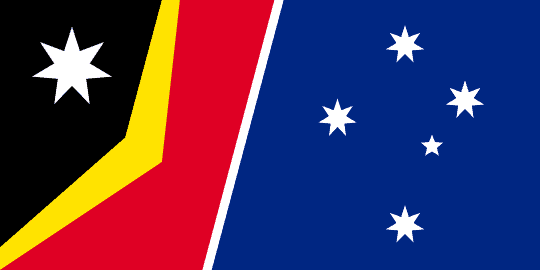
The "boomerang" shape thrilled me, and I still find it very original. Not coincidentally, it's very similar to a proposal to a new Australian flag. The inclined star is also very unique.

Now, a little about the meaning and history of this flag. The flag adopted in 2002 is the same used in 1975, during a brief period of independence. The black represents the "the obscurantism that needs to be overcome", according to official sources, while the yellow triangle represents the traces of colonialism. The red is for the fight for independence, and the white star (on the color of peace) represents the "light that guides". The symbolism, all in all, represents a young nation trying to overcome its problems and build a better future.
 
Your comments are welcome.

Mar 27, 2013

Easter Island (Chile)

Easter Day is next Sunday, and, as I think I won't post again until then, I believe it's an excellent occasion to talk about the very curious Easter Island flag, and try to answer why it hasn't a moai.

The Easter Island is a province of Chile, located in Valparaíso region, constituted by a single namesake commune. The flag of Easter Island is, actually, the flag of rapanui people, although it's widely flown as unofficial flag of both the commune and the province. See it:


Surely no moais. It represents a reimiro, a pectoral ornament whose formant remembers a crescent moon with two characteristic human faces on each extremity or a ship with their own figureheads (reimiros in other shapes also existed). Its meaning and use is unknown, although it possibly was only use by noble women on ceremonial occasions or rituals. It represents, therefore, nobility and authority.

Between 1876 and 1888, this flag was used instead:


The difference in this flag are the four manutaras (Onychoprion lunatus, or spectacled terns), birds with an important role on local mythology.

And why not the moais? To explain it, we should explain the political context where the moai were created. The island inhabitants were divided in two classes: the "long-ears" (the nobles) and the "short-ears" (the commons). Moais were probably made to satisfy the ancestors of the "long-ears"; to made them, the "long-ears" enslaved (yes, it's the correct word) the "short-ears". In the end, during a rebellion, all "long-ears" were killed. And it's the main reason of because the moais are absent of the flags: they are symbol of a shameful past of slavery and oppression, according to the theory of Ron Fischer on its work "Easter Island Brooding Sentinels of Stone".

Happy Easter to all! Feel free to add a comment!

Feb 4, 2013

Australia and New Zealand: Sports

Today's post pays tribute to the flags Australians and New Zealanders use on sportive events. The reason is very simple, you need only to look at this:


It isn't a rare occasion: it occurred, for example, in men's indoor cycling last Olympics game (see evidence). That arrangement is derogatorily known as "Great Britain, Little Britain, Littler Britain", and you can imagine why: Australia and New Zealand are among the four British ex-colonies that still use a British ensign (the others are Fiji, which will change the flag soon, and Tuvalu), all in Oceania. To avoid flags confusion, specially when Australia plays against New Zealand, the two countries have their own unofficial sportive flags.

Australian have the "Boxing Kangaroo" flag (this flag also appears without stars and letters):


The kangaroo is the animal symbol of Australia, everybody knows it, and their ceremonial fights inspired this flag. Green and gold are the national colors of Australia, from national floral emblem, the golden wattle.

Inspired by Australian boxing kangaroo, the New Zealanders came with the "Fighting Kiwi" flag.


Black and white are New Zealand national colors, took from the silver fern, New Zealand national symbol. The kiwi is a symbol of New Zealand, and represent the way New Zealanders colloquially call themselves: "Kiwis".

It's how previous podium would look like if the flags hold by supporters were officially used by national teams:


OK, these flags are funny, but maybe inadequate to appear on more serious situations. Luckily, they have other alternatives; New Zealand, for example, use the "Silver Fern" flag, a very popular proposal to a new national flag:


The silver fern is used as emblem of many sportive teams in NZ, and this is, by sure, much better than the "Fighting Kiwi".

For Australia, the Ausflag (a non-profit organization with tho objective of replace Australian flag) proposed a Australian "sportive flag" on the end of last month, so it's too early to know if supporter will massively adopt it. It's the proposed flag:


It combines the Southern Cross of current flag with green and yellow, the Australian national colors, as I said before. Maybe a golden wattle could be an option, but it's harder to work than Kiwi silver fern.

A new podium:


Ending, it's possible national flags variants with the sportive colors; similar designs are often found on audiences:
  • Australia


  • New Zealand


And a podium with those flags:


I want you to comment, please: What's your favorite podium? Would you suggest other flag or other combination?

Sep 19, 2012

Nauru

The today's flag is very beautiful and has an awesome symbolism: it's Nauru, an island in Pacific Ocean that constitutes a country only bigger than Monaco and Vatican City. However, its flag is worthy of a great nation!


This flag has many characteristics of a great flag: good geometric layout, contrasting colors, simplicity, originality, etc.

It's alright, isn't it? Now let me talk a little about Nauru flag history and symbolism. It was adopted in 1968, being designed by an Australian flag manufacturer. The blue represents, in some way, the ocean. The yellow line represents the Equator, and the white represents the island position just below the Equator. The star is white, representing the phosphate — the great wealth of island in the past —, and is twelve-pointed as expressing the twelve original tribes that have inhabited the country.

What's your opinion about Nauru flag? Please, leave your comment.

Sep 9, 2012

Element of flags: The Southern Cross

Today I'll write about the Southern Cross (also know by its scientific name, "Crux"), a symbol present in flags, coat of arms and other design issues from everywhere in Southern Hemisphere. Maybe, you, in Northern Hemisphere, want to know: what do you see in special in Southern Cross? Myself, a Brazilian, could answer: everything.


[Note: This flag is from Cruzeiro do Sul, Acre, Brazil. For me, the simplest demonstration of Crux majesty]
Firstly, it's important what the Southern Cross means: the South, its ancestors and its lands. During the Antiquity, it was visible in southern Europe and other similar locations. But, in the transition to Middle Ages, approximately, the change of Earth axial inclination hided it until, at least, some thousands of years.

The first time the Southern Cross was saw again by an European was in 1500, during the Discovery of Brazil, by Portuguese astronomer João Faras. Since then, navigators adopted the Crux in the same way the land natives was using it since immemorial times: as a reference mark to Southern Pole (my post about Antarctic flags shows one flag refering to this fact). And it's as a symbol of geographic position that the Southern Cross is used in flags, etc. See a small gallery with some of these flags:


[Click on image to zoom]
The Southern Cross is frequently seen in flags of Argentina, Australia, Brazil, Chile, New Zealand, Papua New Guinea, and Samoa, and it's featured in many of Australia and New Zealand proposals to new flags.

I'm a great fan of Southern Cross, but I must to tell a bad note: the Southern Cross is tattooed, in Australia, with a connotation of  nationalism that sometimes comes near xenophobia. However, I think until many Australia recognizes the Southern Cross as the incredible symbol it is.

If you want to give your opinion about the post or the Southern Cross use in flags, feel free to comment. Thank you!