Showing posts with label Africa. Show all posts

Dec 27, 2015

Ceuta (Spain)

Ceuta is a Spanish exclave in Northern Africa (more precisely, Morocco), a rare reminiscent of centuries of colonization. And with a puzzling flag.

This is the flag of Ceuta:


As I said, Ceuta is considered part of Spain. But the coat of arms in flag is Portuguese, right? More or less...

Yes, it's practically identical to Portuguese coat of arms, and History explains it: Ceuta used to be a Portuguese colony; between 1580 and 1640, Portugal was  united with Spain due to dynastic reasons and, after that, Ceuta was the only former Portuguese colony that chose to stay under Spanish rule.

No, it's not identical to Portuguese coat of arms, but the difference is subtle: the current Portuguese coat of arms has the seven towers arrenged 3-2-2, while Ceuta has the towers arranged 2-2-2-1.

But the Portuguese influence in Ceuta flag is even bigger. That's the flag of Lisbon, capital of Portugal:


The similarity is not coincidence: in 1415, when Portugal conquered Ceuta, the flag flown was that of Lisbon's patron saint St. Vicent (like above, but with coats of arms), apparently inspired by the heraldry of Dominican Order, important for Lisbon history.

In 20th century, the flag of Lisbon gyronny pattern become the standard for Portuguese cities, so the links between Portugal and the flag of Ceuta only grew.

Comments and suggestions are welcome.

Jul 28, 2014

Namibia

How many persons in the world had the luck of designing not one, but two national flags, from two different countries? Frederick Brownwell, that served for almost twenty years as South African state herald, had this privilege and used it to create two of the most awesome national flags around the world.

Apart from being the chairman of the committee that chose Namibian national flag (the public submitted hundreds of entries), Brownwell designed the current South African flag. Clicking here, you can see my review about it.

Here is the current Namibian national flag:


At first sight, you can see some similarities with South African flag that Brownwell designed years after. One is use of many colors, all of them very contrasting with the neighbors. Other, more subtle, is that it incorporates colors from the flags of political parties, what's not uncommon in African continent: its basis is the flag of SWAPO, the main liberation party and that have ruled the country since its independence, but it's visible the similarities with the logo of a traditional opposition party, the DTA.

The colors can also be associated with common symbolism: red for the heroic people, white for peace and unity, blue for the sky and the waters, including Atlantic Ocean, green for the forests and agriculture. The yellow sun represents life and energy.

Long live Brownwell!

Comments are welcome!

Oct 31, 2013

Zaire (1971-1997)

Between 1971 and 1997, the Democratic Republic of Congo was renamed to "Zaire" and under the rule of Mobutu Sese Seko, suffered an attempt of "re-africanization".

Politics apart, the flag of Zaire was very nice:


Initially, a noteworthy point is the creative use of the Pan-African colors (red, green and yellow), dissonant in relation to the more abstract and generic depictions. The color palette is completed with brown, what's very understandable considering the ideal of "African" Zaire. This color is rarely found on vexillology, as well as the lighter shade of green used on the background.

The central charge is also very well-thought. On a green background that symbolizes the hope and confidence of the people, there's a golden disc, whose shape represents unity and whose color remembers the natural wealth of the country. In the center of it, the arm of an African man holding a torch, representing the revolution, with a red flame, whose color stands for the blood of the martyrs.

This is a very beautiful piece of graphic art, specially on more stylized depictions like the one above. The flag goes direct to the point of the Mobutu's ideology, without making it overcharged or cryptic, and without a single word being used. Point to the designer!

Comments are welcome!

Please, avoid the political discussion. This is a post about sole vexillology.
It's the 50th post of the blog. I'd like to thank all the readers!

Jul 9, 2013

Libya, Syria and Egypt

After the last post, I received a request to review the flags of Libya and Syria. Suddenly, I gained a very nice topic, as the forks of the themes are surprisingly numerous. I chose one.

I'll start from the Gadhafi-era Libyan flag:


This flag was adopted when Gadhafi was putting the ideas of its "Green Book" in practice. The green color is associated with Islam since the Fatimid Caliphate, that used a green banner similar to the image above. A flag in full green express, then, the total devotion to Islam and the principles of "Green Book".

The flag is evidently simple, striking and easy to be manufactured, but I can't decide if the simplification is exaggerative or not. Some people liked it, others not. Just for curiosity, plain green flags are used in other parts of the world, like Beni, in Bolivia, and Candelaria, in El Salvador, but we can guess they are not related to Islamism.

After Gadhafi's deposition, a new flag was adopted; more precisely, the design is identical to the flag Libya used during its brief monarchy (1951-1969):


The black field and crescent and moon are derived of the Cyrenaica dynasty of the Senussi, that ruled the unified Libya. Red is for the blood shed on independence process, while green is related to the birth of a new country. Notice that the green in this flag has a different symbolism of the one in Gadhafi-era flag.

Now, starting with Syria (but without forgetting Libya), its current national flag:


This flag was originally adopted in 1958, when Syria and Egypt joined the United Arab Republic. The two stars represent, consequently, the two countries that formed the union. A third star was briefly adopted when Iraq tried to join them, but removed when the attempt failed (because Iraqi Ba'athist government was overthrown). The three stars also represented the three pillars of Ba'athism: unity, freedom and socialism. After that, Libya united Syria and Egypt on the then-named Federation of Arab Republics. The stars were then replaced by the hawk of Qureish (the tribe where Muhammad was born). A very similar flag is still used by Egypt, with the exception that the hawk of Quraish was substituted by the eagle of Saladin.

Syria on Federation of Arab Republics - with hawk of Qureish:


Egypt - with eagle of Saladin:


When the two stars were re-adopted by Syria, the symbolism was changed, although still representing the pan-Arabism: it's now a symbol of Arab unity.

Now, a little about the flag currently used by Syrian rebels:


This flag was the same Syria used after its independence. Here you find another connection to Libya, as Libyan rebels used to use the flags of a previous government (now reinstalled as national flag). The three stars represent the French districts of Aleppo, Damascus and Deir ez-Zor, that formed the unified Syria. The symbolism was soon changed, with the three districts being represented by only one star, with the two remaining representing the joining Sanjak of Latakia and Jebel Druze.

Concluding the text, I hope you noticed how much the flag histories of these three countries are connected. Also, I'd like to point that the examples I cited represent an important characteristic of Arab vexillology: the symbolism related to pan-Arabism. In a wider range, even the use of the pan-Arab colors is a result of this tendency, but no countries have showed this so prominently like Syria and Egypt, with the possible exception  of Iraq. If I can guess, I bet it's related to the influence of Arab nationalism and Arab socialism on the policy of those countries. But it's only a supposition, I may be wrong.

Your comments, suggestions and requests are welcome!

Jan 16, 2013

Botswana

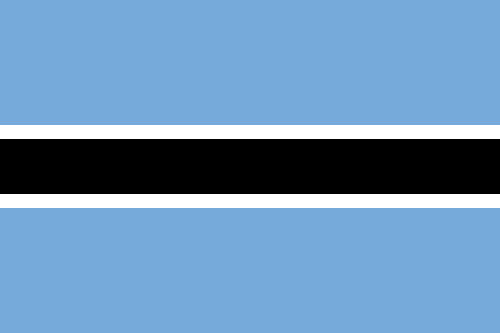
Today I'll talk about other very cute flag: Botswana. I'm sure people from Botswana wouldn't want to change their flag: it's very charming and have a nice symbolism. See this masterpiece:


Some people consider the white-black-blue combination as very cold, but it sure combines very well (previously, I talked about Estonia flag) and is very distinguishable from the red-green-yellow of many African flags. If you don't believe this combination is sufficiently nifty, look at this ties collection. See only one example:


Botswana passed in my "tie test" with honor! Cooler than Botswana flag look, only its symbolism. Blue is from country's motto, literally translated as "Rain" (ironically, "Good luck", too). Black and white represents racial harmony (the flag is from 1966, but no apparent relation with Civil Rights campaign). It also represents the zebras, the supporters of national coat of arms. Every flag with zebras on it (if correctly depicted) is a total winner, and end of discussion!

Please, give your comment! Thanks for reading!

Jan 3, 2013

Tunisia

The first time I ever saw the Tunisian flag, if I record correctly, was in 2002 FIFA World Cup, the world's biggest soccer competition. Turkey also participated in this tournament, and I was intrigued to know the difference between the two flags, and the World Cup album helped. Look at album's cover:

[This image is copyrighted by Panini. I'll use it in fair use.]

What are the most novel flags in this album, in your opinion? It's possible that you pointed Tunisia flag. If you don't know what flag is this, here's a biggest flag:


The genial touch in this flag is the optical illusion: depending of angle, sometimes you see the red crescent and star, sometimes you see the white part. It's a less glamorous version of Mona Lisa's smile.

By the way, do you know the origin of the stars and crescent symbol? It comes from the Ottoman flag (that Turkey still uses), no bigger apparent symbolism. Carthage (that included current Tunisia) is one of the first, if not the first, civilization to use the crescent moon as a religious symbol, but it's hard to say if there's a relation.

The crescent use has disputed origins. Some historians say that the crescent was used by Turk peoples many centuries before it appeared (but the Byzantines and others, too). There's a version that says that it appeared in a dream by Oman I (the founder of Ottoman dynasty). If it's the true origin, there are doubts, but the fact is that it was on the flag of Constantinople when the Ottoman conquered it. And maybe it became, by extension, the flag of all the empire.

And the most impressive part: the Romans probably adopted it in honor to Diana, the Roman moon goddess, a counterpart of Greek mythology's Artemis. So there's a great possibility that the crescent moon has pagan origins. It's the flag of the Turks, not of all Muslims. And it only became a symbol of Muslim faith in Western eyes because of many wars in Holy Land and Eastern Europe between Christian kingdoms and the Ottoman Muslims.

The star accompanying the crescent... It appeared and disappeared many times. Moreover, the number of points varied. Maybe the five-pointed version was fixed because of the Five Pillars of Islam. But it's only a supposition.

Do you liked the post? Did you know the origin of the crescent moon symbolism? Please, leave a comment!

Oct 16, 2012

Element of flags: color palettes

When you're talking about flag, "coincidences" sometimes aren't what they look like. Many times a flag is intentionally similar to another, when the first taking the second as inspiration. An example easy to notice and study are the color combinations. Some flags are very influential, in the sense that's took as base to many newer flags. Here you can see some of them, grouped by the inspiration.

Pan-African colors


There's two palettes of colors known as pan-African colors: one is composed by red, yellow and green, while the other contains red, black and green.

The first set of color (green, yellow and red) is inspired by the flag of Ethiopian Empire.


This three colors have been specially used in Ethiopia since about 17th century, but the flag was only adopted in 1897. The meaning of the colors is disputed, but generally it's said that red is for the blood spilled in defense of Ethiopia , yellow is for the peace and harmony between Ethiopian ethnic and religious groups, and green for hope or land's fertility. The insignia in the middle of the flag is the Lion of Judah, used because the Ethiopian Dynasty claimed to have ancestry from King Solomon and Queen of Sheba, being named Solomonic Dynasty.

As Ethiopia, with exception of a brief period of Italian rule, resisted strongly to European colonization, many countries adopted this colors when gained independence from European countries, as symbol of sovereignty. They are also much used by the Rastafari Movement.

Other set of colors also known as "Pan-African colors" are composed by red, black and green, derived from UNIA (Universal Negro Improvement Association) flag.


The UNIA was founded by Afro-American activist Marcus Garvey, in 1920. It's commonly said that red stands for African blood, black for the African people and green for continent's fertility. It was adopted as an   unofficial "Afro-American" flag and many African countries inspired in it to create their own flags.

Countries in Americas with great African-descendant population, e.g. St. Kitts and Nevis and Grenada, also adopted pan-African colors. See a small flag chart with some African countries with pan-African colors in their flag history:


[Click on images to zoom]

Pan-Slavic colors


Other great flags family is from pan-Slavic. They use the colors red, white and blue. It's important to notice that not all flags with these colors has pan-Slavic inspiration (like France, USA and UK). They are inspired by the flag approved by Pan-Slav Congress of 1848 (occurred in Prague). The colors, associated with freedom and revolution (e.g. French flag) and the same of Russian flag, were chose in a great number of Slavic countries. See the pan-Slavic flag and a flag chart with flags inspired by it.


Pan-Arab colors


Here's a challenge: can you say right now, without assistance, the differences between Kuwait and Jordan flags? You probably don't; if you can, congratulations, because flags of some Arab countries are very hard to be distinguished by non-Arabs. The reason is simple: they all have the same matrix, in this case the flag used during the Arab Revolt (1916-1918). Look at the flag:


The Arab revolt was an attempt to create an unified Arab country under territories of Ottoman Empire (ruled by ethnic Turks). The flag used during the revolt, considered Arab nationalist, was immediately adopted as symbol of Arab identity. See a set of recognized and unrecognized countries that adopt this colors:


It's important to notice that non-Arab Muslim countries, like Afghanistan and Pakistan, don't adopt this colors.

Pan-Iranian colors


Many flags are commonly thought to represent the pan-Arab colors, but actually represents the pan-Iranian colors, used by Persian people, majority in Iran, Tajikistan and Afghanistan. They're based in Persian flag (nowadays Iran); this one is from before 1906 (date unknown).


The small flag chart below show some flags using pan-Iranian colors:


Colors of Federal Republic of Central America


The Federal Republic of Central America (1823-1838) was a good attempt to hold together previous Spanish colonies in Central America, but the union disbanded, although until today they have friendship relationships and there were other attempts of reunification, e.g. the Greater Republic of Central America (1896-1898). See the flag of the Federal Republic:


The color of these flags are blue and white (Costa Rica added the red).


Colors of Gran Colombia


Finally, the last color-based flag family. In a similar case to Central America, the ex-constituent countries of Gran Colombia (officially Republic of Colombia; 1819-1831) adopted the colors of these countries. The unification ideology, influenced by the ideas of liberator Simón Bolívar, is having some voice last years. Gran Colombia used many flags, being the flag below the first and most famous of them:


The colors that defines this family are yellow, blue and red. Bolivia changed the blue by the green. See the flags of this family:


Ending...


This was a long post. Don't you think I deserve at least one comment? Please, if possible, subscribe to the blog. Thank you for reading!

Jul 1, 2012

Tanzania

I never was a great fan of hybrid flags. In some cases, like the United Kingdom, it worked perfectly great, but in a great number of them they look very artificial and result of author's laziness and lack of creativity. Today I'll present Tanzanian flag, so delicately put together that many didn't notice it's a hybrid flag.

Tanzania was formed in 1964 by the union of Tanganyika and Zanzibar, two recently British-independent countries. Not only the name (Tan + Zan = Tanzania), but also the flag of the recently established Tanzania is a mix of the two former countries.

Republic of Tanganyika (1961-1964) People's Republic of Zanzibar and Pemba (1961)

And now note how all the elements of these flags are visible in the United Republic of Tanzania:


You can see Tanganyika flag here, but you can also see the Zanzibar flag (a little upside-down, but you do).  Pretty ingenious, isn't it? The design is so subtle that it looks like a totally original flag.

What do you think about the post? Did you know the curious origin of Tanzanian flag? Comment, please.

May 30, 2012

Malawi

At last May 28th, Malawi changed this flag, or better saying, returned to the model had been used for decades, since Malawi independence. The new-old flag is this:


This flag has only dark colors, what made it a little irritating to eyes. But it's only similar to Kenya flag, and not a lot to be easily confused. Before now, it was used from independence (1964) to 2010, and became a strong nationalist symbol to Malawian people. The rising sun even represents the liberation from European colonialism. The influences to this model is Marcus Garvey flag and the former Biafra flag. In 2010, the government changed the national flag to this design:


Why did they change the flag? Just to leave their mark in history. The last flag is more similar to Marcus Garvey's and Biafra flags. This sun is representing the "incredible" development in Malawi. Two rules explain the reason of popularity disaster:

  1. Not to change what's good.
  2. To change a flag produces costs.

The second rule is the most important: The first national flag was showed in car plates, and would be very expensive to replace every plate — being true, it still hasn't occurred.

And what's your opinion about the Malawi change of flag? Please, comment.

May 16, 2012

South Africa

New governments, when take the power, often change the flags, thinking it'll change the people's feeling. I'm skeptic about it. For me, new flags can't change the people's identity, but change in people's identity can turn necessary a new flag. This occurred with South Africans: in 1994, they changed from the first flag to second:


Of course, I prefer the last. The first flag is a combination of the Dutch "Prince flag" with, in the center, miniatures of flags from United Kingdom and two former Boer republics: Orange and Transvaal. Summarily, only references to European-ethnic people.

With the end of apartheid, the South African citizenship was opened to African-ethnic people. The people's feeling was different, there was an imminent identity reconstruction over the country; the flag wasn't corresponding anymore the people identity. Quickly, it was prepared a provisional flag, that, because its enormous popularity, became permanent. It's the second flag.

The basis of this design is the former flag; if you look behind the pall, you'll see the same tricolor flag. In this case, the red tone is an intermediary between Dutch orange and English plain red. Black, gold and green are the colors from African National Congress flag, used to represent the African-ethnic population.

The presence of the horizontal pall has a special meaning: two people (represented by two legs on left) coming in same direction (the only leg in right).

If you need to present a defect of this flag, I can see a critical one: the flag has six main colors! Probably, it's the only national flag in this condition. But, it's so creative, ambitious and... South African that, if you review, you'll see why this flag still make magic!