Easter Day is next Sunday, and, as I think I won't post again until then, I believe it's an excellent occasion to talk about the very curious Easter Island flag, and try to answer why it hasn't a moai.
The Easter Island is a province of Chile, located in Valparaíso region, constituted by a single namesake commune. The flag of Easter Island is, actually, the flag of rapanui people, although it's widely flown as unofficial flag of both the commune and the province. See it:
Surely no moais. It represents a reimiro, a pectoral ornament whose formant remembers a crescent moon with two characteristic human faces on each extremity or a ship with their own figureheads (reimiros in other shapes also existed). Its meaning and use is unknown, although it possibly was only use by noble women on ceremonial occasions or rituals. It represents, therefore, nobility and authority.
Between 1876 and 1888, this flag was used instead:
The difference in this flag are the four manutaras (Onychoprion lunatus, or spectacled terns), birds with an important role on local mythology.
And why not the moais? To explain it, we should explain the political context where the moai were created. The island inhabitants were divided in two classes: the "long-ears" (the nobles) and the "short-ears" (the commons). Moais were probably made to satisfy the ancestors of the "long-ears"; to made them, the "long-ears" enslaved (yes, it's the correct word) the "short-ears". In the end, during a rebellion, all "long-ears" were killed. And it's the main reason of because the moais are absent of the flags: they are symbol of a shameful past of slavery and oppression, according to the theory of Ron Fischer on its work "Easter Island Brooding Sentinels of Stone".
Happy Easter to all! Feel free to add a comment!
Mar 27, 2013
Easter Island (Chile)
Mar 11, 2013
Pontifical Swiss Guard (Vatican)
The Swiss Guard is the defense force of the Vatican, the smallest sovereign nation in the world and headquarters of the Holy See and the Roman Catholic Church. In a sede vacante period like right now, I was interested to know what flag the Swiss Guard uses when there's no pope. Sincerely, I couldn't find the answer; the only source I found seems to be dubious. However, I think it's interesting to show how's composed the flag of the Swiss Guard. Taking as example, the flag the Swiss Guard used by pope Benedict XVI from 2005 to 2008:
First, a pause to explain what's a Swiss guard: during early ages, kingdoms in all the Europe used Swiss mercenaries as defenders of their courts. However, the papal guard was the only that survived until our times, so it became THE Swiss Guard, and not only another Swiss Guard.
The Swiss Guard flag is square, composed by four cantons, divided by a white cross. In first canton, the coat of arms of the reigning pope (in the case of the flag above, Benedict XVI). In the sede vacante, this is the canton that cause doubts. On the fourth canton, there's always the coat of arms of the pope Julius II, that hired the pontifical Swiss Guard.
The other two cantons have stripes in the colors of the uniform of the guard. Now, a short explanation about the Swiss Guard gala uniform. The legend says it was inspired by a idea by painter and sculptor Michelangelo himself. The uniform was originally striped blue and yellow, the colors of the family of pope Julius II (Della Rovere arms), the same present in fourth canton. His successor, pope Leo X added the red, because his family (the famous House of Medici) colors were yellow and red. So, for about 500 years, it never was greatly changed again.
Ending the flag design, there's the personal coat of arms of then commander of Swiss Guard, that, on the time of above flag (2005-2008), was Elmar Theodor Mäder. Often a pope coexist with more than a commander, often a commander survives for more than a papacy, so the flag is changed more often than a new pope is elected.
Comments are welcome!
First, a pause to explain what's a Swiss guard: during early ages, kingdoms in all the Europe used Swiss mercenaries as defenders of their courts. However, the papal guard was the only that survived until our times, so it became THE Swiss Guard, and not only another Swiss Guard.
The Swiss Guard flag is square, composed by four cantons, divided by a white cross. In first canton, the coat of arms of the reigning pope (in the case of the flag above, Benedict XVI). In the sede vacante, this is the canton that cause doubts. On the fourth canton, there's always the coat of arms of the pope Julius II, that hired the pontifical Swiss Guard.
The other two cantons have stripes in the colors of the uniform of the guard. Now, a short explanation about the Swiss Guard gala uniform. The legend says it was inspired by a idea by painter and sculptor Michelangelo himself. The uniform was originally striped blue and yellow, the colors of the family of pope Julius II (Della Rovere arms), the same present in fourth canton. His successor, pope Leo X added the red, because his family (the famous House of Medici) colors were yellow and red. So, for about 500 years, it never was greatly changed again.
Ending the flag design, there's the personal coat of arms of then commander of Swiss Guard, that, on the time of above flag (2005-2008), was Elmar Theodor Mäder. Often a pope coexist with more than a commander, often a commander survives for more than a papacy, so the flag is changed more often than a new pope is elected.
Comments are welcome!
Feb 26, 2013
Glamorgan (Wales, United Kingdom) [Proposal]
I'd like to add the subtitle "How a flag is born", but I think it would make a great title even bigger. I like this Glamorgan flag proposal not only because it's very attractive but also because it exemplifies how a flag should be created.
Firstly, it's important to say: what's Glamorgan? It's a historic, or traditional, county of Wales. It was formally abolished in 1974, but it resists as a "traditional county" i.e. as a place people still consider to have belonging. It's the flag of Glamorgan:
This flag is, actually, a kind of banner of arms (a rectangular version of the coat of arms) of Iestyn ap Gwrgant, the last Welsh ruler of Morgannwg (do you realize the name similarity?). It was an inspiration to many coats of arms of places in former Glamorgan. See examples:
It even appears of the flag of the city of Cardiff, capital of Wales located on former Glamorgan:
This flag has everything to became the flag of the traditional county of Glamorgan: it's simple, distinctive, well-recognized and unifying (the examples I showed proved the last two). If you're interested on the campaign to a new Glamorgan flag (wherever you live), click here. If you want to find other county flag proposals, click here.
Comments are welcome!
Firstly, it's important to say: what's Glamorgan? It's a historic, or traditional, county of Wales. It was formally abolished in 1974, but it resists as a "traditional county" i.e. as a place people still consider to have belonging. It's the flag of Glamorgan:
This flag is, actually, a kind of banner of arms (a rectangular version of the coat of arms) of Iestyn ap Gwrgant, the last Welsh ruler of Morgannwg (do you realize the name similarity?). It was an inspiration to many coats of arms of places in former Glamorgan. See examples:
Mid Glamorgan
|
South Glamorgan
|
|
|
|
Vale of Glamorgan
|
West Glamorgan
|
It even appears of the flag of the city of Cardiff, capital of Wales located on former Glamorgan:
This flag has everything to became the flag of the traditional county of Glamorgan: it's simple, distinctive, well-recognized and unifying (the examples I showed proved the last two). If you're interested on the campaign to a new Glamorgan flag (wherever you live), click here. If you want to find other county flag proposals, click here.
Comments are welcome!
Feb 13, 2013
Article: The British art of merger
In flags and coat of arms, a merger is usually a political act: it's used to represent the cooperation of two different parts or parties in condition of equality. I like to say it's a British art, for the many occasions it occurred on those lands. See some examples:
Royal badges of England
From 1455 and 1485, the then Kingdom of England lived a dynastic indecision between two rival branches of Plantagenet dynasty: the House of York and the House of Lancaster. The symbol of the House of York was a white rose pointing the bottom, while the House of Lancaster used a red rose pointing the top as insignia. When Henry Tudor (future king Henry VII) unified the two factions and achieved the peace, a new rose was created: the Tudor rose, still used as the royal badge of England.
York rose
|
Lancaster rose
|
Tudor rose
|
Royal badges of United Kingdom
So the Tudor rose became the royal badge of England. After the death of Queen Elizabeth I, the last monarch of Tudor dynasty, there were the Union of Crowns (1603) i.e. the King of Scots (the formal name of the King of Scotland) became automatically King of England. The kingdoms were administered separately, although had the same head of state, until the Acts of Union (1706-1707), that created the United Kingdom of Great Britain, constituted by the two former kingdoms.
The two kingdoms had particular pre-Union histories and, although the capital of new kingdom would be on London (England), the Scots wanted equal representation. A new badge was created, merging the Tudor rose, royal badge of England, and the thistle, the royal badge of Scotland.
In 1800, a similar merge occurred: the Kingdom of Ireland, that was in personal union with Kingdom of England since the Crown of Ireland Act (1572) and, after the Union Act, with the United Kingdom of Great Britain, was unified with the United Kingdom, by acts also name Acts of Union. The badge of the two kingdoms were also merged.
Your comment is welcome!
Maybe, on a future opportunity, I explain the meaning of each one of the flags above: St. George's, St. Andrew's and St. Patrick's crosses.
The two kingdoms had particular pre-Union histories and, although the capital of new kingdom would be on London (England), the Scots wanted equal representation. A new badge was created, merging the Tudor rose, royal badge of England, and the thistle, the royal badge of Scotland.
| Tudor rose (England) | Thistle (Scotland) | Royal badge of United Kingdom of Great Britain |
In 1800, a similar merge occurred: the Kingdom of Ireland, that was in personal union with Kingdom of England since the Crown of Ireland Act (1572) and, after the Union Act, with the United Kingdom of Great Britain, was unified with the United Kingdom, by acts also name Acts of Union. The badge of the two kingdoms were also merged.
| Royal badge of United Kingdom of Great Britain | Shamrock (Ireland) | Royal badge of United Kingdom of Great Britain and Ireland |
The badge didn't change after the independence of Irish Free State (current Republic of Ireland) or the power devolution to Wales, that has its own badges.
Flags of United Kingdom
And the same things that occurred on the royal badges occurred on flags: the St. George's cross, the flag of England, was merged to the St. Andrew's cross, the flag of Scotland, to create the flag of the United Kingdom of Great Britain, that was merged to St. Patrick's cross, the cross-flag of Ireland, to create the flag of United Kingdom of Great Britain and Ireland. There are many proposals to add Welsh representation under the badge, but none approved.
| St. George's cross (England) | St. Andrew's cross (Scotland) | Flag of United Kingdom of Great Britain |
| Flag of United Kingdom of Great Britain | St. Patrick's cross (Ireland) | Flag of United Kingdom of Great Britain and Ireland |
Your comment is welcome!
Maybe, on a future opportunity, I explain the meaning of each one of the flags above: St. George's, St. Andrew's and St. Patrick's crosses.
Feb 4, 2013
Australia and New Zealand: Sports
Today's post pays tribute to the flags Australians and New Zealanders use on sportive events. The reason is very simple, you need only to look at this:
It isn't a rare occasion: it occurred, for example, in men's indoor cycling last Olympics game (see evidence). That arrangement is derogatorily known as "Great Britain, Little Britain, Littler Britain", and you can imagine why: Australia and New Zealand are among the four British ex-colonies that still use a British ensign (the others are Fiji, which will change the flag soon, and Tuvalu), all in Oceania. To avoid flags confusion, specially when Australia plays against New Zealand, the two countries have their own unofficial sportive flags.
Australian have the "Boxing Kangaroo" flag (this flag also appears without stars and letters):
The kangaroo is the animal symbol of Australia, everybody knows it, and their ceremonial fights inspired this flag. Green and gold are the national colors of Australia, from national floral emblem, the golden wattle.
Inspired by Australian boxing kangaroo, the New Zealanders came with the "Fighting Kiwi" flag.
Black and white are New Zealand national colors, took from the silver fern, New Zealand national symbol. The kiwi is a symbol of New Zealand, and represent the way New Zealanders colloquially call themselves: "Kiwis".
It's how previous podium would look like if the flags hold by supporters were officially used by national teams:
OK, these flags are funny, but maybe inadequate to appear on more serious situations. Luckily, they have other alternatives; New Zealand, for example, use the "Silver Fern" flag, a very popular proposal to a new national flag:
The silver fern is used as emblem of many sportive teams in NZ, and this is, by sure, much better than the "Fighting Kiwi".
For Australia, the Ausflag (a non-profit organization with tho objective of replace Australian flag) proposed a Australian "sportive flag" on the end of last month, so it's too early to know if supporter will massively adopt it. It's the proposed flag:
It combines the Southern Cross of current flag with green and yellow, the Australian national colors, as I said before. Maybe a golden wattle could be an option, but it's harder to work than Kiwi silver fern.
A new podium:
Ending, it's possible national flags variants with the sportive colors; similar designs are often found on audiences:
- Australia
- New Zealand
And a podium with those flags:
I want you to comment, please: What's your favorite podium? Would you suggest other flag or other combination?
Jan 16, 2013
Botswana
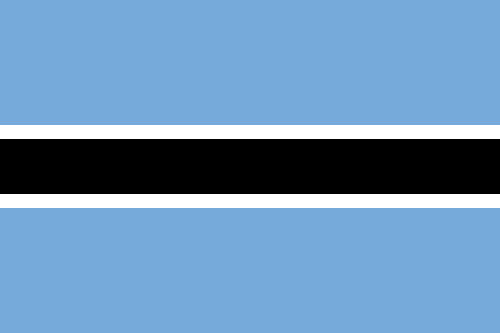
Today I'll talk about other very cute flag: Botswana. I'm sure people from Botswana wouldn't want to change their flag: it's very charming and have a nice symbolism. See this masterpiece:
Some people consider the white-black-blue combination as very cold, but it sure combines very well (previously, I talked about Estonia flag) and is very distinguishable from the red-green-yellow of many African flags. If you don't believe this combination is sufficiently nifty, look at this ties collection. See only one example:
Botswana passed in my "tie test" with honor! Cooler than Botswana flag look, only its symbolism. Blue is from country's motto, literally translated as "Rain" (ironically, "Good luck", too). Black and white represents racial harmony (the flag is from 1966, but no apparent relation with Civil Rights campaign). It also represents the zebras, the supporters of national coat of arms. Every flag with zebras on it (if correctly depicted) is a total winner, and end of discussion!
Please, give your comment! Thanks for reading!
Some people consider the white-black-blue combination as very cold, but it sure combines very well (previously, I talked about Estonia flag) and is very distinguishable from the red-green-yellow of many African flags. If you don't believe this combination is sufficiently nifty, look at this ties collection. See only one example:
Botswana passed in my "tie test" with honor! Cooler than Botswana flag look, only its symbolism. Blue is from country's motto, literally translated as "Rain" (ironically, "Good luck", too). Black and white represents racial harmony (the flag is from 1966, but no apparent relation with Civil Rights campaign). It also represents the zebras, the supporters of national coat of arms. Every flag with zebras on it (if correctly depicted) is a total winner, and end of discussion!
Please, give your comment! Thanks for reading!
Jan 3, 2013
Tunisia
The first time I ever saw the Tunisian flag, if I record correctly, was in 2002 FIFA World Cup, the world's biggest soccer competition. Turkey also participated in this tournament, and I was intrigued to know the difference between the two flags, and the World Cup album helped. Look at album's cover:

[This image is copyrighted by Panini. I'll use it in fair use.]
What are the most novel flags in this album, in your opinion? It's possible that you pointed Tunisia flag. If you don't know what flag is this, here's a biggest flag:
The genial touch in this flag is the optical illusion: depending of angle, sometimes you see the red crescent and star, sometimes you see the white part. It's a less glamorous version of Mona Lisa's smile.
By the way, do you know the origin of the stars and crescent symbol? It comes from the Ottoman flag (that Turkey still uses), no bigger apparent symbolism. Carthage (that included current Tunisia) is one of the first, if not the first, civilization to use the crescent moon as a religious symbol, but it's hard to say if there's a relation.
The crescent use has disputed origins. Some historians say that the crescent was used by Turk peoples many centuries before it appeared (but the Byzantines and others, too). There's a version that says that it appeared in a dream by Oman I (the founder of Ottoman dynasty). If it's the true origin, there are doubts, but the fact is that it was on the flag of Constantinople when the Ottoman conquered it. And maybe it became, by extension, the flag of all the empire.
And the most impressive part: the Romans probably adopted it in honor to Diana, the Roman moon goddess, a counterpart of Greek mythology's Artemis. So there's a great possibility that the crescent moon has pagan origins. It's the flag of the Turks, not of all Muslims. And it only became a symbol of Muslim faith in Western eyes because of many wars in Holy Land and Eastern Europe between Christian kingdoms and the Ottoman Muslims.
The star accompanying the crescent... It appeared and disappeared many times. Moreover, the number of points varied. Maybe the five-pointed version was fixed because of the Five Pillars of Islam. But it's only a supposition.
Do you liked the post? Did you know the origin of the crescent moon symbolism? Please, leave a comment!

[This image is copyrighted by Panini. I'll use it in fair use.]
What are the most novel flags in this album, in your opinion? It's possible that you pointed Tunisia flag. If you don't know what flag is this, here's a biggest flag:
The genial touch in this flag is the optical illusion: depending of angle, sometimes you see the red crescent and star, sometimes you see the white part. It's a less glamorous version of Mona Lisa's smile.
By the way, do you know the origin of the stars and crescent symbol? It comes from the Ottoman flag (that Turkey still uses), no bigger apparent symbolism. Carthage (that included current Tunisia) is one of the first, if not the first, civilization to use the crescent moon as a religious symbol, but it's hard to say if there's a relation.
The crescent use has disputed origins. Some historians say that the crescent was used by Turk peoples many centuries before it appeared (but the Byzantines and others, too). There's a version that says that it appeared in a dream by Oman I (the founder of Ottoman dynasty). If it's the true origin, there are doubts, but the fact is that it was on the flag of Constantinople when the Ottoman conquered it. And maybe it became, by extension, the flag of all the empire.
And the most impressive part: the Romans probably adopted it in honor to Diana, the Roman moon goddess, a counterpart of Greek mythology's Artemis. So there's a great possibility that the crescent moon has pagan origins. It's the flag of the Turks, not of all Muslims. And it only became a symbol of Muslim faith in Western eyes because of many wars in Holy Land and Eastern Europe between Christian kingdoms and the Ottoman Muslims.
The star accompanying the crescent... It appeared and disappeared many times. Moreover, the number of points varied. Maybe the five-pointed version was fixed because of the Five Pillars of Islam. But it's only a supposition.
Do you liked the post? Did you know the origin of the crescent moon symbolism? Please, leave a comment!
Dec 15, 2012
Ohio (USA)
Today I'll talk about non-rectangular flags. The most obvious choice should be the Nepal flag, the only non-rectangular national flag in the world currently in use. As an evaluation of Nepal would present "more variables" than only its shape (look at the video and understand the joke), I'll talk about this flag other day. So I chose the second most famous flag that applies to this subject: Ohio state, in United States of America.
Look at this flag:
The flag is good at first sight, except for some considerations: there are too many stars, and they're arranged in an apparently non-logical layout - although there is explanations: look like there's thirteen stars on the left, as representing the Thirteen Colonies. There are much more symbolism, but I'll cite the five stripes for the five states of Northwest Territory (Ohio itself, Michigan, Indiana, Illinois and Wisconsin), and the big "O" that comes from "Ohio" (although it was someday confused with "Obama").
Oh, and the shape! The Ohio flag's shape resembles more what's called "burgee", generally used by yachts identification, what doesn't make it necessarily inappropriate, however. Some people say it's a kind of "charm" that makes this flag more special, while other people consider that it only turns the flag more expensive and difficult to be produced (personally, I'm part of second group). Changing this flag isn't a high-emergency goal, but it could be recommended.
To know more about flag shapes, I made a small visual dictionary:
Many types, like pennants and streamers, have variant shapes. In a better opportunity I'll post a more complete diagram.
If you have doubts about flag shapes, or only want to express any opinion, please leave a comment.
Observation: Opinions expressed by third-person sites are full responsibility of their authors. Use your critical thinking!
Many types, like pennants and streamers, have variant shapes. In a better opportunity I'll post a more complete diagram.
If you have doubts about flag shapes, or only want to express any opinion, please leave a comment.
Observation: Opinions expressed by third-person sites are full responsibility of their authors. Use your critical thinking!
Dec 5, 2012
Bavaria (Germany)
The flag of German state of Bavaria is one of my favorite flags in all world. It's very simple, but its shape is very catching. Firstly, it's important to clarify which of the Bavarian flags I'm talking about: there're two of them. The first is a very boring bicolor-striped flag. The second has its inclined lozenges that are very cool. Just look at it:
Bayern
[The number of lozenges varies from source by source.]
It looks like a racing flag being shaken, what's very interesting because BMW headquarters are there. By the way, BMW logo includes a stylized Bavarian flag. Have you ever noticed flag?
The coolness of state flag echoed on its capitol city, Munich. The city also use a bicolor flag, but the lozengy variant flag is much more liked.
München
What's your opinion about the Bavaria and Munich flags? Please, leave a comment.
[The number of lozenges varies from source by source.]
It looks like a racing flag being shaken, what's very interesting because BMW headquarters are there. By the way, BMW logo includes a stylized Bavarian flag. Have you ever noticed flag?
The coolness of state flag echoed on its capitol city, Munich. The city also use a bicolor flag, but the lozengy variant flag is much more liked.
München
What's your opinion about the Bavaria and Munich flags? Please, leave a comment.
Nov 20, 2012
Fukui (Japan), Saga (Japan)
It's positively a great flag! I like too much radial symmetry in flags, and it's a great example of it. It's simple, everybody could easily guard all details in memory and after all reproduce them. The flag represents camphor flower, in format of mon (see definition below). The white color represents justice, while red is for passion and loyalty. As a whole, the flag represents "a highly developing harmony".
A "mon" is a stylized figure used as familiar or personal insignia, similarly to Western crests and badges. Click here to confer a gallery of mons.
Now, I'll show the beautiful Fukui prefecture flag, that'll be used to explain other tradition on Japanese flags.
This flag is very colorful, isn't it? Japanese flags are very colorful, usually bicolor or tricolor. Every color can be used in Japanese flags, including some tones that are rare in West, like grey, brown, purple, teal, buff, brownish-green and rose color.
You may be asking yourself "What's this symbol?". This mon is a stylized version of Fukui name transcription in katakana ("フクイ"). A very common technique on these flags is use the name of the entity (or their first syllables) and stylize it as a mon.
I hope you liked the flags and the text. Your comment is welcome, and you're free to ask, suggest, praise, criticize or give your opinion.
Subscribe to:
Posts (Atom)