Sep 27, 2013

Thai Vexillological Association (Thailand)

I took knowledge about the activities of Thai Vexillological Association (TVA) for only few weeks. However, the work has been impressive, in my opinion, especially in their Facebook page (I recommend the visit).

They also have a very clever flag:


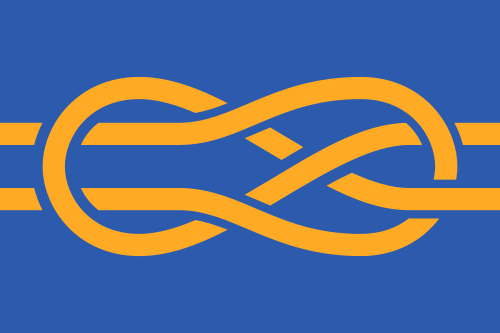
The elephant comes from the flag used by Thailand from the 19th century until 1917; there were variants with a simple and an adorned with royal regalia elephant, and it was actually a white elephant on a red field. It seems obvious the option for the elephant as a royal symbol. On the top of the flag, there's a representation of the sheet knot, initially used by FIAV (Federation of International Associations of Vexillology) and then by many other associations of vexillology; the knot represents the nautical origins of the flags. The knot is adorned with the colors of the current Thailand flag.

The current Thailand flag was adopted in 1917. According to a story, the king Rama VI, when seeing the elephant flag flying upside-down, decided to adopt a totally symmetrical design. Initially, the middle stripe was red, but soon it was changed to blue. The symbology of the colors is the following: red for land and people, white for all religions, and dark blue for monarchy (the astrologers considered the color auspicious to Rama VI). Moreover, the flag was adopted during World War I, and had the same colors of the flags of some Allies: the USA, the United Kingdom and France. Having a good and exclusive design, the flag remains without problems since then.

Your comments are welcome.

Sep 13, 2013

Slovakia

The flag of Slovakia, adopted in 1992, is the following:


Although flags with full achievement of arms are considered a bad practice, simple shields, specially when cleverly executed like in Slovakian case, can generate very good flags. The flag of Slovakia needs to adopt the coat of arms because its plain version is identical to Russia's.

As I said, the flag of Slovakia is very cleverly executed, using only three colors and a very geometric coat of arms in a very equilibrated layout.

The Slovak flag contains the pan-Slavic colors, and is charged with an off-centered coat of arms of the Slovakia. The origins of the coat of arms of Slovakia is the Hungarian coat of arms. While the stripes were more associated with Lower Hungary, the double cross and the mounts were more associated with Upper Hungary (whose territory was similar to current Slovakia). The double cross was used at least since the Crusades, as a Christian symbol and of old usage in the kingdom. The hills represent the Tatra, Matra and Fatra chains, in this order (Tatra and Fatra are in Slovakia).

During the Revolutions of 1848 (also known as "Springtime of the People"), the coat of arms was adopted, when the red-white-green color set (associated with Hungary) was substituted by the pan-Slavic colors, by a "Slovak National Council". In the same time, the current flag (with or without coat of arms) started to be used unofficially. It was used to represent Slovakia in the Czechoslovakia, and adopted by the Nazi-client Slovak Republic. Because of the association with the nazism, the coat of arms wasn't used by the socialist regime, but returned to usage in Slovakia independence.

I hope you liked the post. All comments are welcome.

Aug 29, 2013

European tricolors of compromise

Do you know what the flags of Belgium, France, Andorra, Romania and Moldova have all in common? You may say "they're vertical tricolor flags", but the similarities are even deeper. Let's start on the oldest of them, and I hope you notice the coincidences that deserves a "re-view"!

France


Flag of ParisFlag of France "Ancien Régime"

The Paris militia (that used the city colors on its cockade) was very important to the storming of the Bastille. So, according to Marquis de Lafayette, during the French Revolution the white of the monarchy to the militia's cockade to create the national cockade and, then, the national flag. But there is always that history about "Liberty, Equality and Fraternity"...


The flag of France became influential, what made the vertical tricolor became a common pattern in vexillology. If there wasn't the French Revolution, the flags below, as well as many other, would never have existed.

Andorra


Flag of  FranceFlag of Spain

The flag of Andorra is an example - but I wasn't necessarily talking about flags as much influenced by French tricolor. Andorra is a principality, but, in an only case in the world, it has two co-princes: the president of France and the bishop of the See of Urgell (in Catalonia, Spain). So the background of its flag is like the French flag, but with white changed to yellow to obtain Spanish red-yellow. Curiously, Catalonia province also uses red and yellow.


Belgium


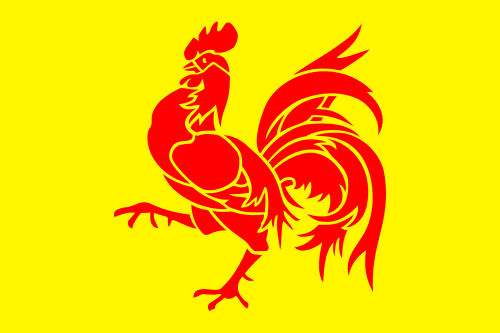
Flag of  Duchy of BrabantFlag of FlandersFlag of Wallonia

The flag of Belgium is, historically, based on the arms of the Duchy of Brabant, that, by the way, later became the coat of arms of Belgium. But you'll commonly find a popular alternate legend to its origin: black and yellow for Dutch-speaking Flanders and red and yellow for French-speaking Wallonia, although it's very anachronistic: Waloon flag was designed in 1913, and adopted in the 1975, and Flanders flag was only officialized in 1973, but the origins of Belgian flag dates from 19th century.


The explanation is so popular that it's present on the rationale, for example, to the nice-looking proposal for a new Belgian flag by Luc Swinnen.

Romania (and Moldova, too)


Flag of Principality of MoldaviaFlag of  Principality of Wallachia

The colors of Romania have their own symbolism: blue for loyalty, perseverance and justice, yellow for generosity, red for bravery and strength. But there's a very famous legend that says that it's formed by Moldavian red and yellow with Wallachian yellow and blue. Transylvania joined before, but, as its flag was also blue-red-yellow, the flag wasn't changed.


The legend is disputed, as the colors were used in some contexts by Wallachia even before the union, but, if it's really true, the republic of Moldova, that adopted a flag based in Romanian one, have the Wallachian colors, too!


I like to find those connections that aren't dubious, as it demonstrates that flags aren't as trivial as we use to think. If you have any suggestion, critique, opinion, etc., you're welcome to comment!

Aug 16, 2013

Brittany (France)

Brittany is a bigger example of flags depicting a heraldic fur. See:


The flag of Brittany depicts nine stripes, representing the nine historical parishes historically used to subdivided the stripes; the five black stripes represent the five parishes where French is spoken, and white represent the four parishes where Breton is spoken. On the superior left canton, we can see a rather unusual pattern: it's a fur!

There are basically two main heraldic furs, being the others mostly variants of them: the ermine (present on the flag above) represents the pelage of the animal of same name, while the vair (rarer in flags) represents the snow pelage of the Eurasian red squirrel.

Noble furs were always very expensive products, so having a fur on your shield, on the Middle Ages, represented mainly nobility. The Dukes of Brittany have, as their coat of arms, a plain ermine field! During the history, the ermine pattern became highly associated with Brittany, being presented in the symbols of many towns of the region.

Although I think the concept of flags made of fur as odd, it's very legitimate that they can be transposed from shields to cloth. After all, sometimes, like above, it generates really charming flags!

Comments are welcome!

Jul 26, 2013

Pakistan

Have you ever noticed that Pakistani flag is so different of the others and still one of most charming national flags in the world?

Let's take a look:


This white hoist makes the flag much more original than the average bichromatic flag, considering it's a very rare composition. Usually, a similar flag would have an unbalanced composition, but the strikingly simplicity of Pakistan flag manages it well.

The flag of Pakistan has a great symbolism, that can be used to explain the history of the country. The flag is based on the All-India Muslim League, that used basically the national flag without its white stripe. The green stripe represents the Islamism (Moghul Empire and the Sultanate of Delhi, some historical rulers of the region, used green flags), the same about the stars and crescent, although it's stated that the former also represents progress, and the latter, light.

The white stripe represents the peace between religions and the religious minorities of the country. Probably, this symbolism was kept from the Indian flag, where orange stands for Hinduism, green for Islamism and white for religious peace. Pakistan flag still represent the Islamic nature of the country, but also the promise for religious tolerance. A nice insight!

Your comments are welcome.

Jul 9, 2013

Libya, Syria and Egypt

After the last post, I received a request to review the flags of Libya and Syria. Suddenly, I gained a very nice topic, as the forks of the themes are surprisingly numerous. I chose one.

I'll start from the Gadhafi-era Libyan flag:


This flag was adopted when Gadhafi was putting the ideas of its "Green Book" in practice. The green color is associated with Islam since the Fatimid Caliphate, that used a green banner similar to the image above. A flag in full green express, then, the total devotion to Islam and the principles of "Green Book".

The flag is evidently simple, striking and easy to be manufactured, but I can't decide if the simplification is exaggerative or not. Some people liked it, others not. Just for curiosity, plain green flags are used in other parts of the world, like Beni, in Bolivia, and Candelaria, in El Salvador, but we can guess they are not related to Islamism.

After Gadhafi's deposition, a new flag was adopted; more precisely, the design is identical to the flag Libya used during its brief monarchy (1951-1969):


The black field and crescent and moon are derived of the Cyrenaica dynasty of the Senussi, that ruled the unified Libya. Red is for the blood shed on independence process, while green is related to the birth of a new country. Notice that the green in this flag has a different symbolism of the one in Gadhafi-era flag.

Now, starting with Syria (but without forgetting Libya), its current national flag:


This flag was originally adopted in 1958, when Syria and Egypt joined the United Arab Republic. The two stars represent, consequently, the two countries that formed the union. A third star was briefly adopted when Iraq tried to join them, but removed when the attempt failed (because Iraqi Ba'athist government was overthrown). The three stars also represented the three pillars of Ba'athism: unity, freedom and socialism. After that, Libya united Syria and Egypt on the then-named Federation of Arab Republics. The stars were then replaced by the hawk of Qureish (the tribe where Muhammad was born). A very similar flag is still used by Egypt, with the exception that the hawk of Quraish was substituted by the eagle of Saladin.

Syria on Federation of Arab Republics - with hawk of Qureish:


Egypt - with eagle of Saladin:


When the two stars were re-adopted by Syria, the symbolism was changed, although still representing the pan-Arabism: it's now a symbol of Arab unity.

Now, a little about the flag currently used by Syrian rebels:


This flag was the same Syria used after its independence. Here you find another connection to Libya, as Libyan rebels used to use the flags of a previous government (now reinstalled as national flag). The three stars represent the French districts of Aleppo, Damascus and Deir ez-Zor, that formed the unified Syria. The symbolism was soon changed, with the three districts being represented by only one star, with the two remaining representing the joining Sanjak of Latakia and Jebel Druze.

Concluding the text, I hope you noticed how much the flag histories of these three countries are connected. Also, I'd like to point that the examples I cited represent an important characteristic of Arab vexillology: the symbolism related to pan-Arabism. In a wider range, even the use of the pan-Arab colors is a result of this tendency, but no countries have showed this so prominently like Syria and Egypt, with the possible exception  of Iraq. If I can guess, I bet it's related to the influence of Arab nationalism and Arab socialism on the policy of those countries. But it's only a supposition, I may be wrong.

Your comments, suggestions and requests are welcome!

Jun 17, 2013

East Timor

Today, we'll look at the flag of one of newest nations in the world: East Timor. Look at this pretty piece:


I remember that the first time I saw the East Timor flag was on a stamp of my country, Brazil, commemorating the first anniversary of the independence of this friend nation, about a decade ago:


At the time, I was slightly more interested in stamps than in flags, but I became immediately curious with the shapes of that flag. I needed more months to found an updated flag section, I can't remember if on an atlas or in the internet.

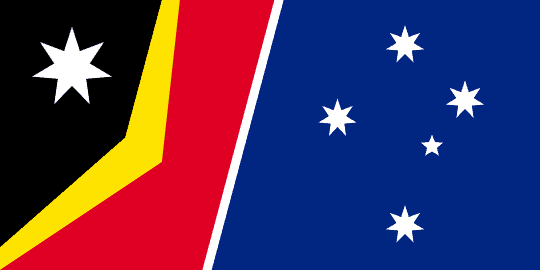
The "boomerang" shape thrilled me, and I still find it very original. Not coincidentally, it's very similar to a proposal to a new Australian flag. The inclined star is also very unique.

Now, a little about the meaning and history of this flag. The flag adopted in 2002 is the same used in 1975, during a brief period of independence. The black represents the "the obscurantism that needs to be overcome", according to official sources, while the yellow triangle represents the traces of colonialism. The red is for the fight for independence, and the white star (on the color of peace) represents the "light that guides". The symbolism, all in all, represents a young nation trying to overcome its problems and build a better future.
 
Your comments are welcome.

Hispanicity / Americas

The flag of the Hispanic people isn't widely seen, in spite of its excellent design and the official status it holds in the whole American continent. Looking at it:


The flag has a white colors, representing peace. The three crosses (known as crosses pattées in heraldry) represent the nao Santa María and the caravels Pinta and Niña, the three ships ceded to Christopher Columbus in the discovery of American continent, as well as the Christianity. They are purple, according to the author of the flag, the Uruguayan army captain Ángel Camblor, in reference to the lion of the kingdom of Leon, later annexed to the Crown of Castile, where the Spanish idiom was developed. The sun represents the Inca sun-god Inti, associated in some countries with the May Sun.

This flag is used in Spanish-speaking Latin America, Hispanic communities in North America, and in Philippines, as an ethnic flag of ethnic people. Its use is most commonly flown in Columbus Day. In those occasions, it's also known as "bandera de la raza" (i.e. "flag of the race").

Moreover, it's officially regarded, in all countries of the continent, as the "flag of the Americas" i.e. as a Pan-American flag independently of ethnic identity, since the seventh assembly of Pan-American Conference, occurred in 1933.

As I said, I think this flag should me much more popular, specially in its use as a Pan-American symbol. Although the flag's symbolism is initially associated with Hispanic ethnicity, some may say Columbus is relevant to the history of the whole continent, and that the sun can be represent the concept of "New World" (as America where known before this name was given) and the liberation process of the continent.

Your comment is welcome. Feel free to comment.

May 20, 2013

England (United Kingdom)

Today's post is inspired by a news that shocked me: the council of Radstock, Somerset, banned the use of St. George's cross (the unofficial, but recognized, symbol of England). The reason is that this flag was used on Crusades, what should offend the Muslim inhabitants of the local, and that it's used by the far right.

About the latter, it's important to remember that every national flag is subject to be used by hatred symbol. Whatever, the biggest polemics is related to the former. The fact that the English flag was originated on the Crusades is irrelevant currently and, on the words of Rizwan Ahmed, spokesman for the Bristol Muslim Cultural Society:
"It is political correctness going a bit too far." 
"Use by the far right is one thing, but to say that Muslims are offended I don't think is correct. We understand the flag is part of this country's heritage, and in fact many many Muslims will identify as being British themselves."
"In actual fact we are normal people. We have a sense of humour and have the same concerns as everyone else – we are not just some single group."
The Saint George's cross:


The Saint George's cross was one of the many flags conceded by the pope to the kings of Europe for being used during the Crusades. Actually, England gained a red flag with a white cross, and France the red cross on white, although they latter exchanged the flags (France latter adopted a white cross on blue).

Here I present a compilation of Crusade flags used during the Crusades to identify nationality (the sources are very confuse, use at your own risk):

  • White cross on red: England (1st), France (2nd).
  • Red cross on white: France (1st), England (2nd), Genoa, Aragon, Holy Roman Empire.
  • White cross on blue: France (3rd).
  • Black cross on white: Brittany, Holy Roman Empire (possibly).
  • Green cross on white: Flanders.
  • Yellow cross on white: Italy, Holy Roman Empire (possibly).
  • Blue cross on white: Portugal (possibly including Galicia).

By the way, the association between the cross and St. George possibly occurred on Genoa, on 12th century,  that also adopted the flag and the patron saint in same period.

I hope you liked the post. If you have any comment about England flag or the incident on Radstock, leave your comment, please.

May 8, 2013

Canada

Today's post has two objectives: firstly, talks a bit about the current Canadian flag and its origin and, finally, comment a news related to this flag.

Until 1965, Canada used this flag:


Then they finally changed to current flag:


Between 1963 and 1965, occurred what was called the "Great Canadian Flag Debate", that gained popular repercussion after Lester B. Person, then prime-minister, proposed that Canada should change its flag. In the end, the right above flag won the debate.

Differently of current absolute acceptance of the maple leaf flag, there were, on the times of the adoption, a loud opposition, fearing that flag change would lead Canada to became a republic and leave the Commonwealth. Until now, fortunately or unfortunately, it never occurred.

The new Canada flag is much simpler, original and distinctive than the older flag, and became so popular that reverting it would cause popular un-satisfaction. Canada flag change happened to create what's called Canadian pale, posteriorly adopted by many Canadian territories and towns.

Now the second part, as promised on first paragraph... since Sunday (May 5th 2013), Canadian naval jack is the new naval ensign, and the naval ensign is the new jack i.e. they exchanged places. The old naval ensign, now the naval jack is the national flag; the new naval ensign (the old naval jack) is the following:


I think the change makes Canada nearer of the standard. Usually (specially on Commonwealth countries), the naval ensigns, by major influence of the United Kingdom, takes the national flag on the canton (what now happens). The jacks use to have simpler designs and, in countries where the naval ensign is different of national flag (like Canada), the national flag is the jack. So I totally agree with the change, as the things makes more sense now.

You may be questioning: what have really changed? According to international protocol, jacks are flown on the bow (front), while the ensigns are flown on the main mast (on sea) or in the stern (if the ship is anchored, moored or alongside).

Please, leave a comment. Your opinion is welcome.